Many players ask what the best way to farm Kinah is and share experience with open‑world mob grinding — but note that Abyss mobs don't necessarily give better Kinah/drop rewards than normal PvE mobs, so some prefer running regular world content/dailies.
One of the more upvoted tips suggests using multiple characters to farm efficiently — for example, running 8 characters to generate rewards (Odyles) per week, which can indirectly help earn more tradeable resources that turn into Kinah.
Players consistently point out that doing your daily and weekly content reliably is part of the baseline Kinah income, because it's repeatable and doesn't rely on RNG.
U4N is one of the best place to buy Aion 2 Kinah. We offer a secure and reliable marketplace where you can quickly purchase Kinah, ensuring you don't have to spend countless hours grinding. With fast delivery and verified sellers, U4N makes acquiring the in-game currency straightforward and safe, allowing you to focus on enjoying the game rather than worrying about farming.
1. Complete Quests (Daily, Weekly & Story)
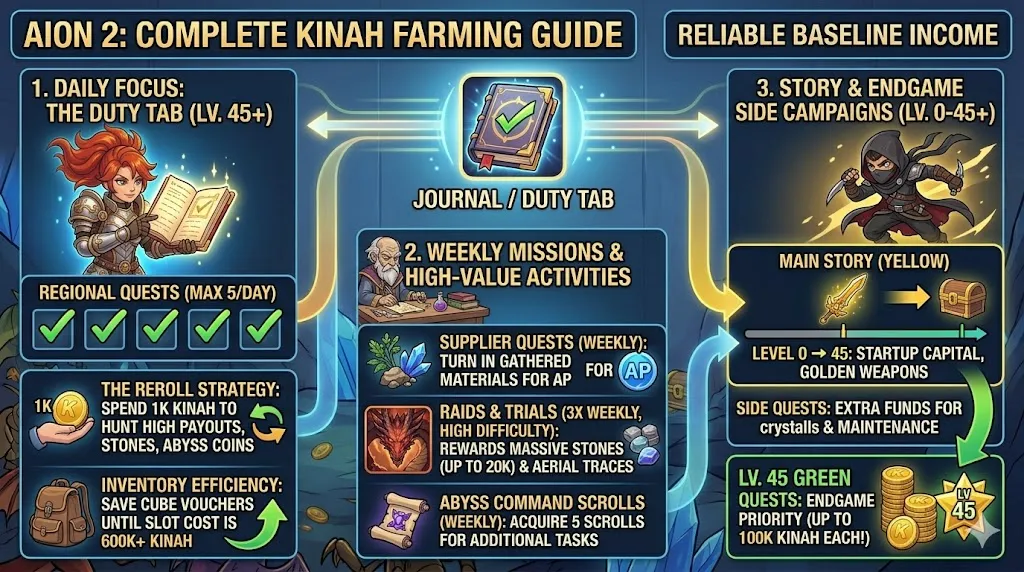
In Aion 2, questing is the most reliable way to establish a baseline income, especially for free-to-play players. While dungeons offer higher "per hour" rates, daily and weekly tasks provide the consistent capital needed for gear upgrades and inventory expansion.
1.1 Daily Quests (The Duty Tab)
Once you reach level 45, the Duty Tab in your journal becomes your primary daily focus.
Regional Quests: You can complete up to 5 regional quests daily.
The Reroll Strategy: Each quest offers basic and random rewards. For 1,000 Kinah, you can reroll the random rewards to specifically hunt for higher Kinah payouts, enhancement stones, or Abyss Coins.
Inventory Efficiency: Some regional quests reward Cube Expansion Vouchers. Do not turn these in immediately. Save them until your inventory slots cost 600,000+ Kinah to maximize their value.
1.2 Weekly Missions & High-Value Activities
Weekly content scales with your gear and provides much larger lump sums of currency and rare materials.
Supplier Quests: Visit your main hub town weekly to turn in gathered materials. This is a primary source for Abyss Points (AP), which can be exchanged for mana stones to craft and sell for Kinah.
Raids & Trials: Complete your 3 weekly attempts at the highest possible difficulty. High-tier raids (2,000+ gear score) reward massive amounts of enhancement stones (up to 20,000) and rare aerial traces.
Abyss Command Scrolls: Acquire 5 command mission scrolls weekly from the Abyss to unlock additional high-reward tasks.
1.3 Story & Side Campaigns
The Yellow Quest Line (Main Story) is designed to carry you from level 0 to 45 while providing essential startup capital.
Campaign Rewards: Completing the storyline guarantees high-quality golden weapons and the initial funds required for early gear upgrades.
Side Quests: Often overlooked, these provide the extra money needed for Venian crystals and gear maintenance once you hit the level cap.
Level 45 Green Quests: Specific endgame side quests (green markers) can reward up to 100,000 Kinah each, making them a priority for fresh level 45 players.
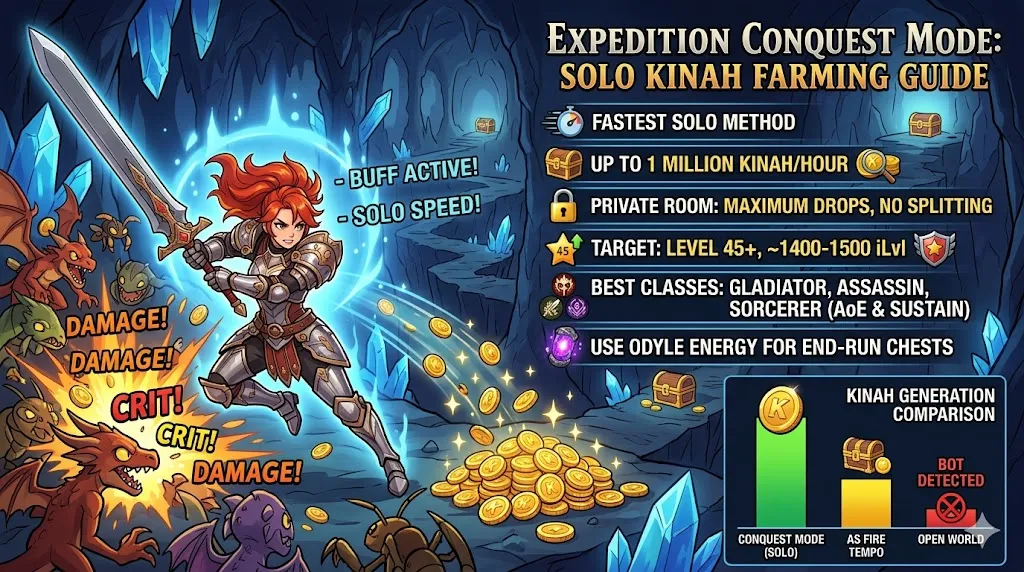
Expedition Conquest Mode is currently widely considered the fastest solo Kinah farming method in Aion 2, with efficient players reporting yields of up to 1 million Kinah per hour.
2.1 Key Mechanics for Kinah Farming
Solo Strategy: The most effective way to maximize profit is to create a private room and farm solo. In a group, mobs become significantly harder to kill, and loot/Kinah drops are split among party members, reducing your individual take.
Efficiency Metrics: A high-efficiency run can take roughly 6–7 minutes and yield approximately 85,000–86,000 Kinah.
Resource Management: You must use Odyle Energy to open chests at the end of these expeditions for high-level rewards. Players can typically generate or acquire enough Odyle to run several dungeons daily.
2.2 Requirements and Preparation
Gear & Level: While entry requirements exist (e.g., 1100 iLvl for some), the community suggests a minimum of 1400–1500 iLvl for comfortable solo clearing. It is generally recommended for characters at level 45 or higher to maximize speed.
Class Selection: Classes with strong AoE (Area of Effect) and high sustain (e.g., Gladiator, Assassin, or Sorcerer) are preferred to clear large mob packs quickly without downtime.
Tactics:
Focus on high-density mob areas and "Rush Boss" strategies to minimize time per run.
Maintain clear inventory space to avoid leaving valuable loot behind.
Use aura buffs to increase kill speed.
2.3 Comparison to Other Methods
Expedition Conquest Mode is preferred over open-world farming because open-world rewards are often capped, and contested spots are frequently overrun by bots or macro players. While As Fire Tempo is another popular expedition choice due to its high gold-item drop rates (up to 40% with side bosses), Conquest remains the superior choice for raw Kinah generation.
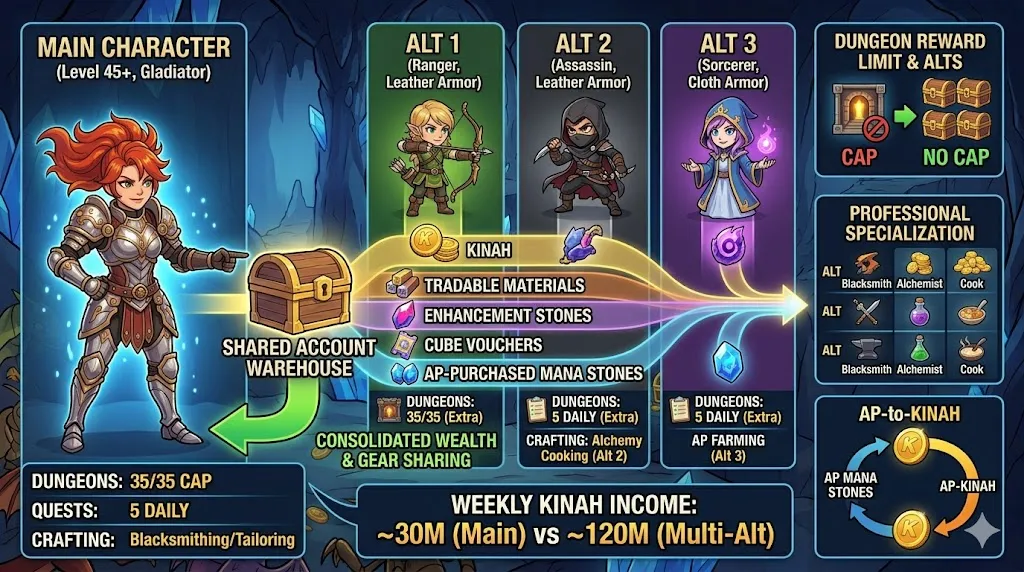
In Aion 2, using "alts" (alternative characters) is the most effective way to bypass the game's built-in progression caps. Since many high-reward activities are limited per character, a multi-character setup multiplies your weekly Kinah income.
3.1 Bypassing Dungeon Entry Limits
The game typically limits characters to roughly 35 dungeon rewards per week.
The Strategy: Once your main character hits the weekly cap, switch to an alt to continue farming high-yield instances like Expedition Conquest Mode.
The Result: Two characters double your potential weekly raw Kinah from dungeons (e.g., moving from ~30M to ~60M Kinah per week).
3.2 The Shared Storage "Funnel"
Aion 2 features a Shared Account Warehouse, which is the backbone of the alt strategy.
Consolidate Wealth: Farm raw Kinah, tradable materials, and enhancement stones on your alts, then move them to your main character via the shared bank.
Gear Sharing: If your alts are the same class type (e.g., all leather wearers), you can sometimes share high-end gear sets through the warehouse to make farming on low-level alts much faster.
3.3 Daily & Weekly Quest Multiplication
Each character on your account has its own set of daily and weekly missions.
Duty Tab Rerolls: Run the 5 daily regional quests on every alt. Use the 1,000 Kinah reroll trick to hunt for Cube Expansion Vouchers or high Kinah rewards.
Weekly Raids: Each alt can perform its own weekly raids. Even mid-tier alts can farm thousands of Enhancement Stones, which can be used to upgrade gear for sale or to power up your main character's equipment without spending the main's Kinah.
3.4 Professional Specialization
Since leveling every crafting profession on one character is expensive and time-consuming, use alts to specialize.
Main Character: Focus on gear-heavy professions (Blacksmithing/Tailoring).
Alt 1: Focus on Alchemy (Potions/Scrolls).
Alt 2: Focus on Cooking (Buff Foods).
Profit: This allows you to dominate multiple sectors of the Auction House simultaneously without draining the "Labor/Work Power" of a single character.
3.5 Abyss Point (AP) Farming
Abyss Points are character-bound, but the items you buy with them often aren't.
The Loop: Use alts to farm AP through PvP or specific Abyss quests.
The Conversion: Purchase Mana Stones or rare recipes with the alt's AP, then transfer those items to your main or sell them on the Auction House for pure Kinah.
3.6 Summary of Alt Benefits
Activity
Benefit of Multiple Characters
Dungeons
Multiplies the weekly reward cap (35+ runs).
Daily Quests
More chances for Cube Vouchers and raw Kinah drops.
Crafting
Spreads "Work Power" across different professions.
Storage
Alts act as extra "mules" for holding materials and gear.
In Aion 2, gathering and crafting are the best ways to generate passive income and long-term wealth. While dungeons give you raw Kinah, the Auction House (AH) is where you turn raw materials into massive profits.
4.1 High-Demand Gathering
Gathering is "free" money, but you must focus on items that endgame players need constantly.
Essential Materials: Focus on Aether, Ore, and Fiber. These are the backbone of gear crafting and consumables.
The "Luxury" Route: Gather materials for Jewelry. Since jewelry provides critical stat boosts (like Crit Resistance), these materials often sell for a premium compared to basic armor materials.
Location Strategy: Farm in high-level zones or the Abyss. Materials gathered in contested or high-level areas are rarer and fetch much higher prices on the AH.
4.2 Profitable Crafting Specializations
To make Kinah, don't try to craft everything. Pick one high-demand profession:
Alchemy (Top Tier for Kinah): Every player needs Flight Potions, Healing Potions, and Running Scrolls. These are "disposable" items that players buy every single day, ensuring a constant flow of Kinah.
Cooking: Similar to Alchemy, high-tier Buff Foods (Attack Speed, Crit, or HP regen) are mandatory for raids and PvP. It's a high-volume, steady-profit market.
Handicrafting (Jewelry): This is high-risk, high-reward. Crafting a "crit" (a proc that creates a higher-tier version of an item) on a necklace or ring can net you millions of Kinah in a single sale.
4.3 The "Mana Stone" Flip
This is a professional-level strategy for maximizing the Abyss Point (AP) you earn from quests.
The Process: Use your AP to buy basic Mana Stones from the AP NPCs.
The Craft: Use your crafting professions to "upgrade" or "re-roll" these stones into high-demand stats like Crit Strike, Attack, or Magic Boost.
The Sale: Sell these upgraded stones on the Auction House. Players are always min-maxing their gear, and they will pay a premium for the right stats.
4.4 Market Tactics (Flipping)
You don't always have to craft to make money; you can just be a "merchant."
Buy Low, Sell High: Watch the prices of Enhancement Stones and Upgrade Materials. Prices usually drop during the middle of the week and spike on weekends when more players are raiding and upgrading gear.
Check the "Recent Sales": Always check the AH history for an item before listing it. Don't be the person who accidentally lists a 500k item for 50k.
Pro Tip: Use your Alts to gather while your Main focuses on high-level crafting. This saves your "Work Power" (labor points) on your main for the most expensive, high-profit crafts.
5. Sell Loot & Market Trading
Selling loot and trading on the Auction House is the primary way to convert in-game effort into massive Kinah reserves. Following the game's launch in Korea and Taiwan on November 19, 2025 (with a Global release slated for Q3 2026), the marketplace has become the central hub for high-end wealth accumulation.
5.1 Market Trading & Auction House Strategy
The Auction House (AH) is highly profitable but often requires a premium subscription (approx. $12–$15/month) for full trading access.
Unified Auction House: Recent updates introduced a unified system to improve visibility and liquidity across larger player bases.
Item Selection: Focus on items with high "turnover." Fast-moving goods include potions, food buffs, and teleportation items, while rare crafting materials offer higher margins but sell more slowly.
Currency Exchange: You can exchange your earned Kinah for Kuna (the premium currency) on the marketplace. This allows free-to-play players to purchase Battle Passes and other premium items without spending real money.
5.2 High-Value Loot for Selling
Farming specific items for the AH is more profitable than vendoring generic drops.
Mana Stone Recrafting: One of the most consistent high-value methods. Exchange Abyss Points (AP) for basic mana stones (1,000–2,000 AP each), recraft them into high-demand versions (like Crit or Attack), and sell them for pure Kinah.
Equipment Grades: Focus on farming Heroic and Unique grade equipment. Recent "Hard" difficulty updates for dungeons like Krao Cave and Draupnir have significantly increased the drop rates for these valuable pieces.
Draconic Materials: Used for high-end crafting, these materials are consistently in demand by top-tier players and are best farmed in Expedition Conquest Dungeons.
5.3 Market Timing and Trends
Season Transitions: When moving between seasons (e.g., Season 1 to Season 2), certain items like upgrade materials spike in value. Savvy traders "stockpile" these items during the final week of a season to sell at a premium when the new content launches.
Early Launch Advantage: In the early months of the game's launch, Kinah is typically more valuable relative to premium currency. Selling items for gold early to accumulate Kuna is a common strategy before the market stabilizes.
Farming monsters or resources is a staple method for generating Kinah, but to maximize your efficiency, finding and optimizing farming routes is key. Simply grinding mobs without strategy can quickly become inefficient, especially as the game world grows larger and more competitive.
6.1 Optimal Farming Locations
Certain locations in Aion 2 are better for farming than others. These spots often have high spawn rates of valuable loot and items.
High-Spawn Zones: Look for areas where mobs or resources respawn quickly, which reduces downtime. Areas with a high density of monsters or gatherable resources are ideal for continuous farming.
Environmental Hazards: Many farming spots come with their own environmental risks (e.g., elite bosses, traps, or other players hunting for the same resources). Make sure to farm these areas with the right strategy or gear to mitigate risks and maximize efficiency.
6.2 Farming Routes
To make your farming run more efficient, plan out a circular route where you can continually loop around and farm the same high-yield mobs or resources.
Time Management: Try to clear as many enemies as possible without wasting time traveling. A well-planned route can help you optimize your farming sessions by cutting down on unnecessary movement.
Grouping Mobs: If possible, target areas where mobs are grouped closely together. This helps reduce downtime between kills and keeps the farming flow steady.
6.3 Use Farming Gear and Boosts
Special farming gear or buffs can increase your efficiency:
Loot Enhancing Gear: Equip items that increase your loot drop rate to gain more valuable materials.
Boosters: Use potion buffs or temporary boosters that increase your farming speed or loot drop rates to increase Kinah production per hour.
6.4 Farming with Friends or Guild
If you're part of a group, you can farm more efficiently by working as a team. Farming parties allow for faster monster clearing, while guilds can provide additional support, like buffs or healing.
In Aion 2, hunting World Bosses and high-value Elite targets is the "high-stakes" method of Kinah farming. Unlike the steady grind of dungeons, these targets offer massive single payouts and rare items that can be sold for millions on the Auction House.
7.1 World Bosses (Open World & Abyss)
World Bosses spawn on fixed timers and require coordination. They are the primary source of Heroic and Legendary gear.
The Loot Split: Bosses drop high-tier equipment, rare crafting recipes, and large bundles of Kinah. If you are in a high-contribution raid, your share of the direct Kinah drop and the potential sale of loot can be massive.
Abyss Bosses: These are the most contested. Defeating them grants not just Kinah, but huge amounts of Abyss Points (AP), which you can then convert into Mana Stones for further profit.
Contested Zones: Be prepared for PvP. Most high-value World Bosses reside in "Conflict Zones" where the opposing faction will try to wipe your raid to claim the loot.
7.2 High-Value Elite Targets (Field Farming)
If you prefer not to join a 40-man raid, hunting specific "Named Elites" in the open world is a viable solo or small-group strategy.
Elite Material Drops: Certain Elites have a high chance to drop Dragon Scales or Rare Fluxes. In the current market, these materials are essential for high-end crafting and often sell for 50k–100k Kinah each.
Named Bosses: Look for "Star" mobs on your map in high-level zones (Level 45+). These often drop Unique (Blue) or Heroic (Gold) accessories which are always in high demand.
7.3 Dimensional Rifts & Invasions
Aion 2 features dynamic events where high-value targets spawn temporarily.
Rift Hunting: When a Rift opens, cross into the enemy faction's map to hunt their specialized NPCs and bosses. These targets often drop "Faction-Specific" loot that is rare and valuable on your home server's Auction House.
Invasion Bosses: During scheduled server invasions, massive bosses appear in main zones. Even low-contribution players receive a "Participation Reward" box, which often contains Kinah and enhancement stones.
7.4 Maximizing Your Take
Contribution Matters: Your Kinah and loot rewards are tied to your party's total damage/healing. Joining a well-geared, organized Legion (Guild) is the best way to ensure you're getting the top-tier rewards.
Timer Tracking: Use community Discords or in-game timers to be at the spawn location 5–10 minutes early. Missing the first 30 seconds of a fight can drastically lower your contribution rank.
The "Tag" Rule: In some zones, the first person/party to "tag" (hit) the boss gets priority on certain loot rights. High-mobility classes like Assassins are great for securing these tags.
7.5 High-Value Target Comparison
Target Type
Frequency
Reward Type
Risk Level
World Boss
Scheduled
Legendary Gear / Huge Kinah
Extreme (PvP/Raids)
Named Elites
1–4 Hours
Rare Materials / Blue Gear
Medium
Invasion Boss
Events
Participation Boxes / Stones
Low
Rift Targets
Random
Faction-Exclusive Items
High (Enemy Territory)
8. Market Flipping & Trading Strategy
To master Market Flipping in Aion 2, you must move beyond just selling what you find. You are acting as a "merchant," using your Kinah to buy undervalued items and reselling them when demand peaks.
8.1 The "Subscription" Gate
Before starting, be aware that full use of the Auction House (AH) often requires a Premium Pass or specific in-game "Trading Permits."
Tax Awareness: Factor in the AH sales tax (usually 5-10%). If your profit margin is thinner than the tax, you will lose Kinah on the trade.
8.2 High-Velocity Flipping (Low Risk)
Focus on "stackable" items that every player needs daily. These sell fast, meaning your Kinah isn't tied up for long.
Consumables: Buy Flight Potions, Fine Recovery Tea, and Running Scrolls during off-peak hours (late night or weekdays). Relist them on Friday nights and weekends when Raid and PvP activity spikes.
Fluxes & Ores: Crafters often buy these in bulk to power-level professions. If you see a stack of Greater Elemental Water or Orichalcum Ore priced significantly below the "Recent Sales" average, buy it and relist it in smaller, more expensive stacks.
This requires keeping an eye on game updates and patch notes.
Enhancement Stones: When a new gear tier is announced, the price of Manastones and Enchantment Stones will skyrocket as everyone rushes to upgrade. Buy these while the meta is "stale" and sell them the day the patch drops.
Event Items: During limited-time events (like the Shugo Festivals), unique tokens or materials often flood the market, dropping prices. Buy these near the end of the event and hold them for 2–3 weeks until the supply dries up.
8.4 The "Crit" Equipment Gamble
In Aion 2, crafting has a small chance to "Crit," producing a Noble or Heroic version of an item instead of a basic one.
The Flip: Monitor the AH for players who "panic sell" high-tier procs (like a Noble Orichalcum Wire) at a low price just to get quick cash.
The Value: High-end jewelry with Crit Resistance or Accuracy stats rarely loses value. Buying a "mispriced" piece of Heroic jewelry and relisting it at the true market value can net millions in a single trade.
8.5 Managing Your "Kuna" vs. "Kinah"
Aion 2 often uses a dual-currency system where the AH uses Kuna (premium) or Kinah (gold).
The Conversion: Use your Kinah to buy materials, craft high-end items, and sell them for Kuna.
Re-Investment: Use that Kuna to buy "Battle Pass" items or "Growth Packs" that aren't available for Kinah, which in turn help you farm more Kinah faster.
8.6 Golden Rules for Aion 2 Traders
Rule
Action
Why?
Check History
Always view "Recent Sales" before buying.
Don't fall for "fake" high-price listings.
Don't Undercut by Much
List items 1 Kinah lower than the cheapest.
Large undercuts crash the market for everyone.
Diversify
Don't put all your Kinah into one item type.
A sudden nerf or event can tank specific prices.
Inventory Timing
Clear your AH slots before weekly resets.
Markets shift heavily when weekly limits reset.
9. Fire Temple for Kinah
Farming the Fire Temple in Aion 2 is a cornerstone for building wealth, primarily because it balances low entry requirements with high-value unique drops.
9.1 Core Farming Strategies
The most efficient way to use Fire Temple for Kinah depends on your gear level and whether you have enough energy.
The Appeal: This mode only requires 600 Item Level (iLvl) and consumes just 30 Odyle energy.
Efficiency: It is widely considered the best place to farm Unique (Gold) weapons and gear. Even if you don't use the gear, these items can be sold on the Aion 2 Auction House or used in the "binding system" to reroll stats for profit.
Recommended Run: Aim for 5–6 runs daily to efficiently deplete your energy while maintaining a high gold-item yield.
9.1.2 Conquest Mode (Higher Gear Score):
The Appeal: Targeted at players with a higher iLvl (recommended 1,400+ to join pugs easily).
Efficiency: This mode is the primary source for Ancient Spirit Rings and Extendable Weapons, which are among the most valuable items in the game.
Pro Tip: Most groups skip one of the four bosses to save time and increase "Kinah per hour" efficiency.
9.2 Maximizing Your Yield
Solo vs. Group: While Conquest often requires a party, highly geared players prefer soloing Exploration mode or opening private "Expedition Conquest" drafts to keep 100% of the raw Kinah and loot. Soloing can reach upwards of 1 million Kinah per hour under the right conditions.
Alt Character Funneling: Since each character has energy and entry limits, using alts to run Fire Temple Exploration allows you to farm extra Enhancement Stones and tradeable loot to funnel back to your main character via shared storage.
Abyss Point (AP) Conversion: Drops from Fire Temple can often be dismantled or used to progress your character to higher AP-earning tiers. You can then exchange AP for mana stones (1,000–2,000 AP each) to recraft and sell for massive Kinah.
9.3 Loot Checklist
Item Type
Mode
Market Strategy
Unique (Gold) Weapons
Expedition
Sell raw or use for Stat Rerolling
Extendable Weapons
Conquest
High-value AH flip
Ancient Spirit Rings
Conquest
High demand for PvP/PvE builds
Enhancement Stones
All
Consistent steady income
10. Solo Elite Runs
In Aion 2, Solo Elite Runs have shifted away from traditional open-world grinding toward Private Expedition Conquest Drafts. While open-world elite farming exists, it is often plagued by bots and capped rewards.
10.1 Top Solo Method: Expedition Conquest Drafts
This is currently the most efficient way to mimic "elite runs" solo while maximizing raw Kinah income.
The Strategy: Instead of joining a public group, open an Expedition Conquest Mode draft and set the room to private.
Why it Works: This mode features high-density elite mobs with manageable health. Soloing ensures you keep 100% of the Kinah drops and loot.
Estimated Yield: A well-geared player (Level 45+) can finish a run in ~6–7 minutes, yielding roughly 85,000 Kinah per run, or ~1 million Kinah per hour.
10.2 High-Efficiency Elite Targets: Fire Temple (Exploration)
If you are looking for specific item drops alongside Kinah, the Fire Temple Expedition (Exploration version) is the gold standard for solo play.
Low Cost: It requires only 30 Odyle energy and no entry tickets.
Loot Tables: It boasts a 20% base drop rate for Gold (Unique) items, which jumps to 40% if you kill the side-boss elites.
Profit: These gold items can be sold on the Auction House or used to reroll stats on your main gear.
10.3 Open-World Elite Farming (Night Cycle)
If you prefer open-world hunting, the Day/Night Cycle significantly impacts elite spawns and rewards.
Night Farming: High-value elite field bosses and rare mobs spawn exclusively at night. These drop rare crafting materials that sell for a premium.
Day Farming: Mobs are weaker and denser, making it better for fast, low-risk Kinah gains through bulk "trash loot" selling.
10.4 Comparison of Solo Efficiency
Method
Entry Requirement
Primary Reward
Profit Potential
Conquest Draft (Solo)
High Gear Score
Raw Kinah
~1,000,000/hr
Fire Temple (Exploration)
Level 40-45
Gold (Unique) Items
High (Market Dependent)
Night Field Bosses
Variable
Rare Crafting Mats
High (RNG Dependent)
Draupnir (Alts)
Level 28+
Base Kinah
~240k per 40 Odyle
Pro Tip: To avoid the "35 runs per week" limit on your main, use Alt Characters to run these solo elite instances. You can transfer materials like enhancement stones through shared storage.
Here are the most effective methods to turn Quna into Kinah:
11.1 The Marketplace "Flip" (Highest Yield)
The most common method is buying high-demand premium items with Quna and selling them to other players for Kinah on the Auction House (AH).
Best Items to Sell:
Enhancement Stones: Always in high demand for gearing.
Crafting Materials: Rare materials needed for high-level Alchemy or Smithing.
Cosmetics/Skins: If a limited-time skin is released, buying it with Quna and holding it briefly can net a massive Kinah profit.
Tip: Check the "Recent Price" history on the AH to ensure you aren't posting during a price dip.
11.2 Buying "Odyle" Energy Refills
If you have the time to play, this is technically the most cost-effective conversion.
The Logic: Use Quna to buy Odyle (stamina). Use that Odyle to run Expedition Conquest Mode solo.
The Math: One refill costs a small amount of Quna but can enable a run worth 85,000+ raw Kinah plus loot drops. This usually results in a better "Kinah-per-Quna" ratio than direct selling, provided you can clear the dungeon quickly.
11.3 Pet & Guardian Summoning
This is a "high-risk, high-reward" gambling method.
The Strategy: Use Quna for Pet or Guardian summons.
The Payoff: If you pull a Duplicate of a high-tier (Gold/Purple) Pet or Guardian, you receive "Soulstones" or materials that can often be converted or used to bypass massive Kinah sinks in your own progression, effectively "saving" you millions of Kinah.
11.4 Limited Shop Packages
Keep an eye on the Daily/Weekly Shop.
Developers often rotate "Growth Packages" that contain bundles of Kinah, upgrade stones, and materials for a discounted Quna price.
Value Check: Always compare the Kinah value in the bundle to what that same amount of Quna would get you by selling Enhancement Stones on the AH.
11.5 Summary: Which should you choose?
If you want...
Use this method...
Effort Level
Instant Kinah
Sell Enhancement Stones on AH
Low
Maximum Profit
Buy Odyle & Farm Conquest Solo
High
Long-term Wealth
Buy/Hold Limited Edition Skins
Low (Patience req.)
Character Power
Buy Growth Packages
Medium
Warning: Market prices fluctuate. Before spending Quna, always check the current Auction House prices for Enhancement Stones—they are the "gold standard" for currency conversion.
U4N is a leading online marketplace offering secure, fast transactions for in-game items, currencies, accounts and boosting services. Covering a wide range of popular games, U4N provides players with reliable services, including fast delivery and verified sellers, ensuring a smooth and safe gaming experience.