In MLB The Show, a player's attributes determine how they perform on the field — both in simulation and when you control them. Higher numbers mean better performance in that area. These attributes combine into your overall rating (OVR) in modes like Diamond Dynasty and Franchise.
MLB The Show 26 Best Attributes At Each Position
In MLB The Show 26, the importance of attributes varies by position to maximize defensive efficiency and offensive output. A major update in this year's game is the Split Fielding Reaction, which replaces the single universal reaction stat with four directional ratings (Left, Right, Forward, and Backward).
Positional Attribute Priorities
Position
Primary Defensive Attributes
Key Offensive Attributes
Catcher (C)
Blocking, Arm Strength, Fielding
Contact, Clutch
First Base (1B)
Fielding (to avoid dropped throws)
Power, Contact
Second Base (2B)
Reaction (Directional), Fielding
Contact, Speed
Third Base (3B)
Arm Strength, Reaction
Power, Contact
Shortstop (SS)
Fielding, Arm Strength, Reaction
Speed, Contact
Left Field (LF)
Fielding, Speed
Power, Contact
Center Field (CF)
Speed, Reaction, Fielding
Contact, Vision
Right Field (RF)
Arm Strength, Fielding
Power, Contact
Pitching Attributes
For both Starting Pitchers (SP) and Relievers (RP), the following are most critical for competitive play:
H/9 (Hits per 9): Directly impacts the size of the opponent's PCI (Plate Coverage Indicator). Separate ratings now exist for performance against Right and Left-handed batters.
Control (CTRL): Influences the PAR (Perfect Accuracy Region) size for each individual pitch.
Pitching Clutch: Replaces H/9 and K/9 when runners are in scoring position.
Velocity & Break: Essential for creating speed differentials and movement to induce weak contact.
Note: HR/9 is strictly a simulation attribute and does not affect human-controlled gameplay.
Universal Offensive Tips
Clutch: In MLB The Show 26, the Clutch attribute replaces Contact whenever runners are in scoring position.
Vision: Increases the timing window for swings and expands the outer PCI, making it vital on higher difficulties.
Speed: Critical for center fielders to cover ground and for top-of-the-order hitters to create scoring opportunities.
HITTING ATTRIBUTES
These attributes affect how good a batter is when at the plate:
Contact vs L/R – How consistently a batter makes solid contact against left‑ or right‑handed pitchers. Higher means bigger PCI (the strike‑zone hit box) and better timing.
Power vs L/R – How much power a batter has, influencing extra‑base hits and homers against left‑ or right‑handed pitching.
Vision – Determines how well a hitter can track the ball and affects PCI size/movement.
Discipline – Affects the ability to recognize balls vs strikes and avoid chasing bad pitches.
Clutch – Helps hitters perform better in late or high‑leverage situations.
Durability – Impacts injury likelihood and stamina during long games or seasons. (Not active in every competitive mode.)
FIELDING & DEFENSE ATTRIBUTES
These determine defensive performance:
Fielding – General ability to field ground balls, catch fly balls, and make plays.
Speed – How fast a player moves in fielding and on the bases.
Arm Strength – Determines how hard a fielder can throw the ball.
Arm Accuracy – How accurate those throws are.
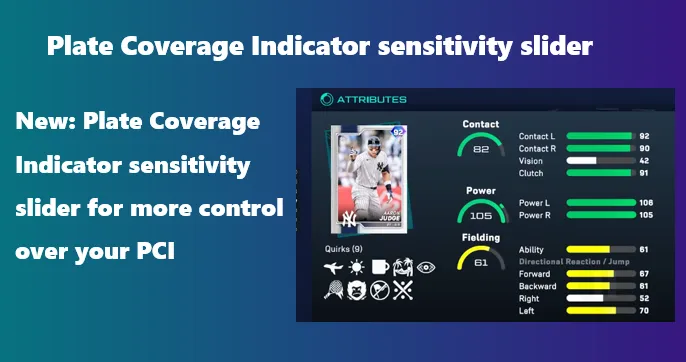
Reaction (Directional) – MLB The Show 26 splits reaction into multiple sub‑components (like forward, backward, left, right) to make defense feel more realistic.
Catcher Pop Time – New in 26: measures how fast and efficient a catcher can throw to catch a baserunner.
PITCHING ATTRIBUTES
Pitching is deeper and more nuanced in 26, especially with left/right splits:
H/9 (Hits per 9) – How often a pitcher gives up hits, now split vs lefties and righties to reflect real‑world matchups.
K/9 (Strikeouts per 9) – How often a pitcher gets strikeouts; also split vs L/R.
Control – Tracks how well a pitcher locates their pitches (formerly BB/9); affects the Perfect Accuracy Region (PAR).
Velocity (VEL) – Maximum speed of fastballs and other pitches.
Break (BRK) – How much movement a pitch has (curves, sliders, etc.).
Clutch (PCLT) – How well a pitcher performs in high pressure situations, including earning special “Bear Down” pitches in tight moments.
Pitch Repertoire Usage – New in 26: the game now considers how often specific pitches are used in real life, influencing control and effectiveness.
For those looking to boost their progress more quickly, you might want to explore options to buy MLB 26 stubs cheap. With services like U4N, you can get the stubs you need to enhance your squad without the grind, allowing you to focus on playing the game and enjoying it to the fullest. Just make sure you're choosing a reliable platform to ensure a smooth experience.
NEW/UPDATED MECHANICS IN THE SHOW 26
MLB The Show 26 doesn't just tweak numbers — it also changes how some attributes play in game:
Split Fielding Reaction: Reaction is no longer a single stat; it is now split into four directional attributes (Left, Right, Forward, and Back). This makes a fielder’s first step more realistic based on where the ball is hit.
Pop Time: Previously tied to arm strength, this is now a dedicated attribute for catchers. It specifically affects how quickly a catcher can release the ball on stolen base attempts.
Pitch Repertoire Usage: Every pitch in a pitcher's arsenal now has a "Usage Rating" based on real-world MLB statistics. Highly used pitches have a smaller Perfect Accuracy Region (PAR), making them easier to locate than rare or secondary pitches.
Pitching Clutch: Now influences the new "Bear Down" mechanic, determining how many special "clutch" pitches a pitcher can store and how quickly they earn them by throwing strikes.
Batting Clutch: Continues to replace the Contact attribute when runners are in scoring position.
Hitting
PCI Sensitivity & Anchor — New controls to fine‑tune the Plate Coverage Indicator movement.
Big Zone & Fixed Zone — New hitting options that change how contact and timing work.
Pitching
Bear Down Pitching — Earn enhanced pitches in high leverage; tied to Clutch attribute.
Split Ratings — Pitchers now have separate effectiveness vs left vs right handed hitters.
Defense
Directional Reaction — More detailed defensive responses instead of a single reaction stat.
Pop Time for Catchers — Adds explicit catcher defensive depth to control steal outcomes.
MODES & ATTRIBUTE Usage
In Road to the Show (RTTS), your created player's attributes are something you upgrade and directly impact your performance.
In Diamond Dynasty (DD), attributes dictate how cards perform in games and online matchups.
In Franchise/Simulation, ratings drive CPU performance and player development but don't require manual aiming.
Attribute Customization
A new Parallel XP (PXP) system for Diamond Dynasty allows for Parallel Mods, which let you choose specific attribute boosts as you level up cards (up to P5) to either fix weaknesses or enhance strengths.
U4N is a leading online marketplace offering secure, fast transactions for in-game items, currencies, accounts and boosting services. Covering a wide range of popular games, U4N provides players with reliable services, including fast delivery and verified sellers, ensuring a smooth and safe gaming experience.